-
Using mitmproxy reverse mode for API testing
29 June 2026
Read moremitmproxy is my preferred proxy for API testing these days. I'm using it mostly in reverse mode though, so I thought I'd capture my setup in case it's useful for anyone else. My main use case is to inspect the traffic coming into the API server and being returned, mostly when running tests against it. Where mitmproxy is typically used as a proxy to monitor traffic passing into/out of a client application, for this I'm concerned with the server's handling. Reverse mode lets me inspect and adjust the traffic as I go along. I start up the proxy, configure the tests to point to it instead of the actual server, and I'm all set.
-
Planets and Webhooks: a simple Flask app
22 July 2020
Read moreAs a Developer Advocate for an API company, I spend a lot of time talking about APIs and webhooks and HTTP in general. Recently I've been focussing on HTTP tools, but I really wanted a very simple example API that I could use that would return JSON but really let me focus on the tools, not the API. So I created a "Planets and Webhooks" API with a couple of GET endpoints to return JSON data, and another endpoint to receive and log incoming webhook data.
-
HTTPMock for Testing a Golang API Client
30 March 2020
Read moreI'm working on an API client for some Nexmo APIs and having tests to work through the various responses that the API can return and check that it does what I expect has been very handy so I thought I'd share my thoughts. I've got a bit of a head start here too since the OpenAPI specs have example responses in them that I can grab and feed to the mocking tool I'm using in my tests!
-
HTTP Toolbox
27 February 2019
Read moreAs Web Developers, we need to know how to work with HTTP from every angle. I gave a 2-hour tutorial at PHP UK that included some of my most trusted tools - but it was sold out and a bunch of people asked me if there was video (there wasn't, tutorials make little sense when videoed). Instead, I thought I'd try to set out a self-study version of the workshop (I rarely teach these days so I'm unlikely to deliver it anywhere else).
There's a slide deck, some exercises and a sample repo on GitHub ... let's dive in!
-
Test Web Requests with a Local RequestBin
14 December 2018
Read moreI've been a long-time fan of RequestBin, but it's no longer active since it suffered so much bad traffic. It's never been too difficult to set up locally and when I tried to do that last week, I realised it has got even easier because it now has a docker-compose configuration.
-
Make a POST Request from PHP With Guzzle
18 September 2018
Read moreI work extensively with APIs and a variety of serverside scripting languages, and best practice does change over time. Many of the most popular posts on this blog are 10 years old, because apparently I was interesting in 2008. Two in particular from around that time relate to making POST requests from PHP ... and I'd do it completely differently today. So, in an attempt to overcome some of the past crimes of the Internet in general and PHP in particular: here's how to make a POST request in PHP, today, in a PHP 7+ world (it probably works in PHP 5 too).
-
HTTP Tools Roundup
03 July 2017
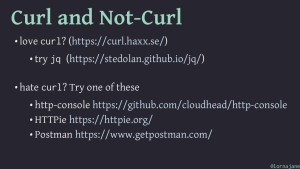
Read moreAt a conference a few days ago, I put up a slide with a few of my favourite tools on it. I got some brilliant additional recommendations in return from twitter so I thought I'd collect them all in one place in case anyone is interested - all these tools are excellent for anyone working APIs (so that's everyone!). First, my original slide:
-
Changing Content Type with Slim Framework
17 September 2013
Read moreSlim framework has recently invaded my life, I picked it up for a hobby project, recommended it to a client who then contracted me to do quite a lot more development, and it's also used for m.joind.in. One thing that has tripped me up a couple of times …
-
Twitter Search API Using PHP and Guzzle
11 July 2013
Read moreIn case you missed it, Twitter updated their APIs recently, so that you have to authenticate to use even their search APIs to return publicly-available results. This is an increasing trend for API providers, to provide either very limited or nonexistent access for unauthenticated users, I think so they can rate limit consumers that swamp them. To cut a long story short, that meant I needed to update my dashboards that keep an eye on twitter searches to do more than just call file_get_contents in the general direction of the right URL.
-
Setting Multiple Headers in a PHP Stream Context
07 May 2013
Read moreLast week I tried to create a PHP stream context which set multiple headers; an Authorization header and a Content-Type header. All the examples I could find showed headers built up as a string with newlines added manually, which seemed pretty clunky and not-streams-like to me.
In fact, you've been …
-
Pretty-Printing JSON with Python's JSON Tool
15 April 2013
Read moreToday's quick tip is something that was widely retweeted after my "Debugging HTTP" talk at the ever-fabulous WhiskyWeb conference last weekend. When working with JSON on the commandline, here's a quick tip for showing the JSON in a nicer format:
curl http://api.joind.in | python -mjson.tool
You need …
-
Endpoints for HTTP Testing
07 February 2013
Read moreWhile working on a book ("PHP Web Services" from O'Reilly, not out yet but soon!) recently, I was looking for some place I could make HTTP requests to, to show off how to make different kinds of requests with different tools. On my own machine, I have a couple of scripts that chatter back giving debug information about the requests that were made, but I wanted to get the tools examples going without any additional dependencies at all. I hadn't used anything like these tools before, but I found quite a few alternatives, so I thought I'd share what I came up with.
-
Adding Custom Headers to Every Request with Chrome
10 April 2012
Read more I'm working on an API which uses OAuth2, but it also has an HTML output handler so I actually do quite a lot of my development in the browser for read-only stuff (I wrote an earlier article about output handlers including the HTML output handler). I fell across an extension …
 -
Building A RESTful PHP Server: Understanding the Request
19 January 2012
Read moreOnce upon a time, what seems like a lifetime ago, I was away for a couple of weeks, and I wrote a series of posts about serving RESTful APIs from PHP to keep my blog going while I was away. Fast forward a few years and those posts are outdated and still wildly popular - so I thought it was about time I revisited this and showed how I'm writing RESTful PHP servers today!
In the first part of this (probably) 3-part series, we'll begin with the basics. It might seem boring, but the most important thing to get right with REST is parsing all the various elements of the HTTP request and responding accordingly. I've put in code samples from from a small-scale toy project I created to make me think about the steps involved (should I put the code somewhere so you can see it? Let me know). Without further ado, let's dive in and begin by sending all requests through one bootstrap script:
-
Retrieving Data from Google Analytics API using PHP
09 December 2010
Read moreRecently I started playing with the google analytics API, looking at ways to bring analytics onto dashboards and generate simple reports from the data in there. Very shortly after I started to look at the API, I had working data retrieval, so I thought I'd share my experiences (and code!).
-
Curl and Cookies
12 November 2010
Read moreI noticed the other day that the cheat sheet I have on this site for curl doesn't show how to use cookies, so I thought I'd remedy that omission, and quickly! Being able to use the command line to authenticate and then go on and use part of a site …